Most people contact Velit support assuming there is a problem with their heater causing it to not function reliably. Our support data shows that about 9 times out of 10 the issues with the heater is NOT a problem with the heater unit iteself, but rather related to issues with fuel delivery/ fuel lines.
Most of the time, by reviewing this article, small hurdles with fuel delivery can be easily rectified and you can get your heater functioning reliably as needed.
Fuel delivery is extremely critical in terms of reliably and proper function of our heaters. So we always recommend before assuming there is an issues with your heater unit, maybe consider evaluating your fuel lines, or replacing them altogether.
Need extra fuel line? Available on Amazon here: https://a.co/d/03yuq4n7
(It's highly recommended to always carry extra spare fuel line for repairs in the field if needed)
Most Commonly Overlooked Fuel Delivery Problems
1. Fuel pump should be located within 3 feet of fuel tank.
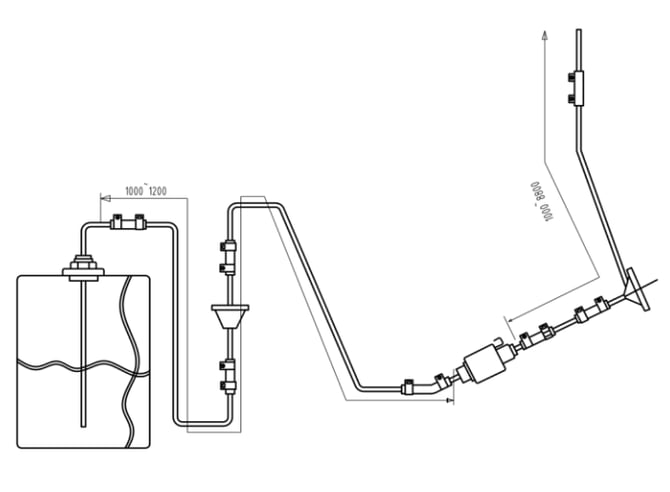
The fuel pumps for these heaters are inherently weak on the vacuum / pull side of the pump. This is why we spec that the fuel pump should be located within 3 feet of the fuel source. The pump can push fuel up to 20 feet, but issues on the vacuum/pull side of the line can impact pressures and dosage of fuel on the push side of the line.
2. If running at elevations above 6k feet, use the included metal fuel standpipe instead of vehicle Aux fuel port taps.
Elevation can come into play at as little as 3.5k feet but typically around 6k feet is where start seeing issues. For ultimate reliability of our heaters above 6k feet, we recommond installing the metal fuel standpipe with 2mm inside diameter, and avoiding use of the factory AUX fuel port connectors.
3. Ensure proper fuel filter position and use (often not needed on plastic tanks).
We often recommend not using or removing fuel filters from many heater users installs because they often cause more problems then they are worth. Typically, with a plastic fuel tank like most vans have, where the standpipe also does not go al the way to the bottom, there is little chance of contamination or foreign objects in the fuel. Adding a fuel filter to the already inherently weak vacuum side of the fuel line provides a measurable degradation in fuel delivery. We incude a fuel filter in our kits so that we include everything you could need, but that does not mean its use is required in every installation. Fuel filters have a tendency to collect air bubbles which impact fuel delivery negatively by absorbing pressure. Often, to install fuel filters according to specs in our manual, additional length/line is needed, which is not ideal for the side of the line you are trying to keep short and simple. With serviceable fuel filters, they can also be a source of air leaks if they are not screwed tight. Fuel filters are meant for use when there is known contaminants to the fuel supply, such as an old VW bus with a metal tank and lots of debris from tank age, for example.
In the below graphic, you can see to correctly position the filter, a lot of extra fuel line length must be added, which is often not worth doing. Without filter, you can achieve a much shorter and simpler vacuum/pull side of the fuel lines:
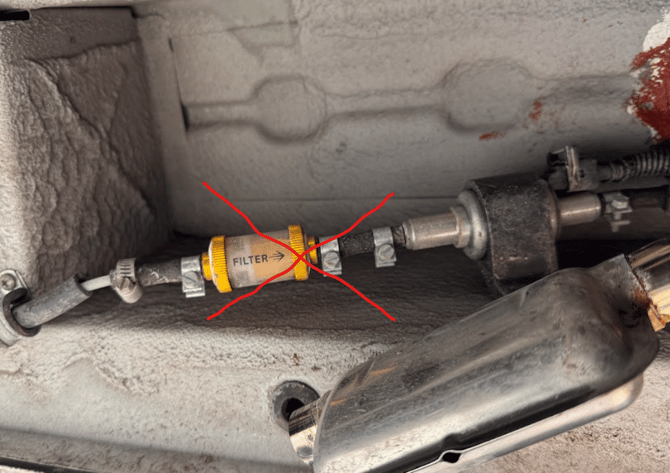
Do not install fuel filter directly in front of fuel pump with single rubber connector, this is out of spec. as shown below:
4. Ensure fuel lines are cut with sharp blade and not scissors or cutters.
Even cable cutters leave the lines pinched/crimped and do not leave a clean edge on the line. We recommend using a sharp blade and a cutting board to cut the lines cleanly, sharply, and squarely without deforming the end of the line. This is because you want that line to make a smooth transition from the end to the next section of line, pump, or heater.
5. Ensure nylon fuel lines are butted up against other line/pump inside rubber connectors.
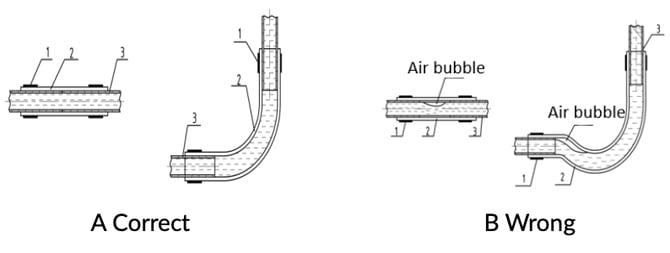
Anywhere an air bubble can live, it will. Ensure you butt-up the nylon fuel lines against each other inside the rubber connectors as best as possible. Marking the lines outside the connector before inserting to ensure you know when they are in as far as they need to be to touch the other side connection. This includes when connecting to the fuel pump, filter, standpipe, or heater itself.
6. Ensure clamps are tight, but not over-tightened.
We recommend using a socket instead of a screwdriver for tightening fuel line clamps. You want to tighten them snuggly, not loose, but also not overly tight. Over-tightening clamps can potentially crush nylon fuel line or damage rubber connectors. Loose clamps can leak air and degrade fuel delivery.
7. Ensure to use 2-2.5 mm inside diameter hard nylon fuel lines, not rubber hoses for fuel lines.
Only use the fuel line/type supplied with our heater kits. Do not use 3rd party soft rubber lines. Do not use black nylon lines specified for other heater brands. These heaters rely on our hard plastic lines to allow proper fuel delivery dosage and pressure for proper ignition and combustion. Softer fuel lines absorb impulse pump pressures, resulting in fuel not being delivered at the right dosage or pressure to correctly atomize and combust in the burn chamber.
8. Ensure fuel line quality and integrity.
At any point in time your fuel lines can be degraded. This could be from being exposed to the elements, road hazards, critters, or conflicts with other moving parts for example. The fuel lines have the potential to rub against sharp edges or hot exhausts, potentially puncturing or melting the fuel lines. Fuel lines can also degrade naturally over time and should be inspected or replaced every 1-2 years as needed. This is why it's important to always have spare fuel line with you as sourcing our specific type can take time when in critical need for heater function.
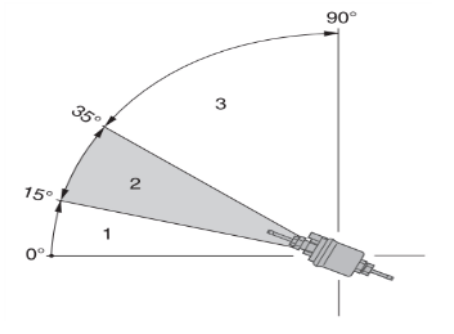
9. Ensure fuel pump is on a proper, slightly upward-pointing angle.
A slightly upward pump angle at the outlet enables any air bubbles to escape and move up and out of the lines to the heater. If the pump is pointing downward or level the bubbles can become trapped and impact fuel delivery negatively. Remember the pump is what controls the dosage and pressure needed for the heater to ignite and combust reliably.
10. Ensure you are top-drawing fuel and that you are not drawing fuel from the bottom of the tank with gravitational pressure.
We have seen many cases where fuel is supplied from the bottom of a fuel tank, which is out of specifications for what these heaters call for. The fuel should ALWAYS be top-drawn from a vented tank, and not bottom-fed. We have seen many heaters run poorly when bottom-fed due to gravitational pressures working against the designed vacuum design of how these pumps are supposed to operate.
11. Check for air bubbles in clear fuel lines while starting/running the heater.
Last but not least, when all other items have been checked, you need to watch the fuel in the lines when the heater is running or attempting to start, to check for any air bubbles. Some small bubbles leaving the pump each time the pump clicks are normal, but any other air bubbles should be concerning. If you have looming around your fuel lines you'll need to remove them or cut windows to evaluate if air bubbles are present in any parts of the fuel lines. Looming can be good for protecting the fuel lines, but also makes it difficult to check for air bubbles, which is often a tell of fuel delivery issues that need to be addressed.
12. Only use 2-2.5mm inside diameter nylon (hard) fuel lines provided with heater kit.
Do not use other fuel line types such as rubber fuel lines or other softer fuel line types. Do not use black nylon fuel lines provided by other heater manufactures which have a smaller inside diameter.
13. Do not use T-fittings tap into existing fuel systems, fuel must be top-drawn from standpipe. Each heater requires it's own standpipe.
Do not tap into existing high pressure behicle fuel systems. T-fittings are problematic for a few different reasons and cannot be used. We've tested this on our bench as well as fixed many heaters having issues that were attempted to run this way.